
Fair Compensation in the No Surprises Era: A Data-Driven Approach for Healthcare Stakeholders
The No Surprises Act, implemented to shield patients from unexpected medical bills, has dramatically altered the landscape of healthcare billing and reimbursement. While achieving its primary goal of patient protection, the Act has introduced new complexities that significantly impact both healthcare providers and payers.
Providers face challenges with potentially undervalued Qualified Payment Amounts (QPAs) from payers that could threaten their financial stability and ability to provide quality care. Conversely, payers grapple with the task of calculating fair QPAs, many times based upon 2019 claim reimbursements, that balance cost control with the need to maintain robust provider networks and ensure patient access to care. The implementation of the NSA has faced significant legal scrutiny, with the Texas Medical Association (TMA) at the forefront with multiple cases, highlighting the ongoing tension between providers and insurers over fair compensation and the interpretation of the Act.
At the heart of this tension lies the critical role of the QPA in determining out-of-network reimbursements. Recent price transparency mandates have emerged as a potential part of the solution, offering both sides powerful tools to navigate this new terrain. Providers and payers can leverage price transparency data to ensure fair compensation, maintain financial viability, and ultimately uphold the spirit of the No Surprises Act while serving patient interests.
Price Transparency Data Availability
The availability of healthcare pricing data came in two forms starting in 2021. Hospital machine-readable files (MRFs) became available starting on January 1, 2021, following the implementation of the CMS Hospital Price Transparency Rule. Payer machine-readable files, as part of the Transparency in Coverage Rule, became available later, on July 1, 2022. These regulations were part of broader efforts to increase transparency in healthcare pricing, allowing consumers and other stakeholders to access detailed pricing information.
Providers Positioning of Transparency Data in QPA Negotiation
The impact of the NSA across the provider community varies significantly based upon Specialty and whether located in urban or rural areas. Anesthesia, Radiology and ER have seen significant impact and high volumes since the NSA inception, with Anesthesiologists experiencing payment reductions up to 60% due to low QPAs in some cases. The use of data is critical in the negotiation process with payers, and ultimately the dispute resolution process. The availability of price transparency data can provide several benefits to providers, including:
Determine median in-network rates for specific services and CPT codes, accounting for geographic location, facility type, and provider specialty.
Present clear comparisons between QPAs and rates calculated from transparency data, highlighting patterns of consistent underpayment across services.
Propose fair payment rates based on analysis, possibly accelerating resolution during negotiation period.
Support during dispute resolution process.
Efficient QPA Calculation and Gap Fill for Payers
There has been significant scrutiny towards payers and the calculation of the QPA since the inception of the No Surprise Act. When initially established, payers were required to utilize 2019 claims and contract data in order to calculate the QPA on NSA-eligible claims. Even today, the guidance provided is to utilize 2019 data, and account for CPI increases in order to calculate the QPA for eligible claims. The availability of price transparency data can provide administrative efficiencies, including:
Utilize in-network contract rates published by payers regionally and nationally to land at current median rates across specialties.
Remove both high dollar and low dollar outliers that historically drove inaccurate median rates.
Develop a clear, repeatable process for QPA calculation and methodology that can be referred to in dispute resolution.
Model impacts of different calculation methods on QPAs.
Closing the QPA Gap between Providers and Payers
Price transparency data offers valuable tools for both providers and payers in navigating the complexities of the NSA, the QPA calculation and ultimate agreement between provider and payer on the QPA. By leveraging this data effectively, all parties can work towards a system and process that fairly compensates providers efficiently, lowering the administrative burden and cost being experienced.
Deerhold Delivers QPA support TODAY!
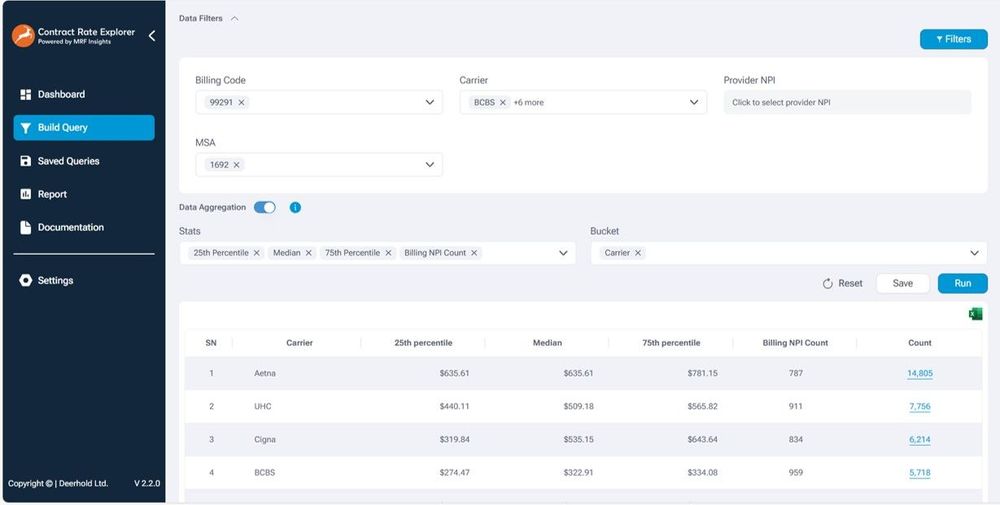
For over 20 years, Deerhold has provided analytic solutions across the healthcare industry, most recently ingesting price transparency data from payers regionally and nationally. The price transparency data only includes contracted rates for providers that have performed those specific services within the last 12 months, resulting in data that aligns perfectly with a fair QPA calculation that can be immediately utilized by providers and payers. Deerhold strives to work with our provider and payer customers to accelerate resolution of NSA eligible claims, avoiding the arbitration process and saving all constituents significant time and money.