
The U.S. healthcare system is among the most expensive in the world, with total expenditures surpassing $4.3 trillion annually, accounting for nearly 18% of the nation’s GDP. Despite these staggering costs, the pricing of healthcare services has historically been an ambiguous metric, making it challenging for stakeholders—especially employee benefit brokers and stop-loss organizations—to effectively evaluate and manage healthcare costs for their employer group customers.
Traditionally, brokers and stop-loss carriers have relied on "percent off billed charges" data from insurance carriers to assess the value of provider networks. However, this approach is deeply flawed. Billed charges are often arbitrary, inflated, and wildly inconsistent, varying significantly between providers and even for the same services. The result? Misleading metrics that fail to reflect the true comparison of provider networks.
A Shift Toward Transparency: The Medicare Advantage
The Transparency in Coverage (TiC) Rule is changing the game. For brokers and stop-loss organizations, the rule provides unprecedented access to contract rate data, enabling a significant shift from arbitrary billed charges analysis to more standardized benchmarks that allows for generally accepted comparison.
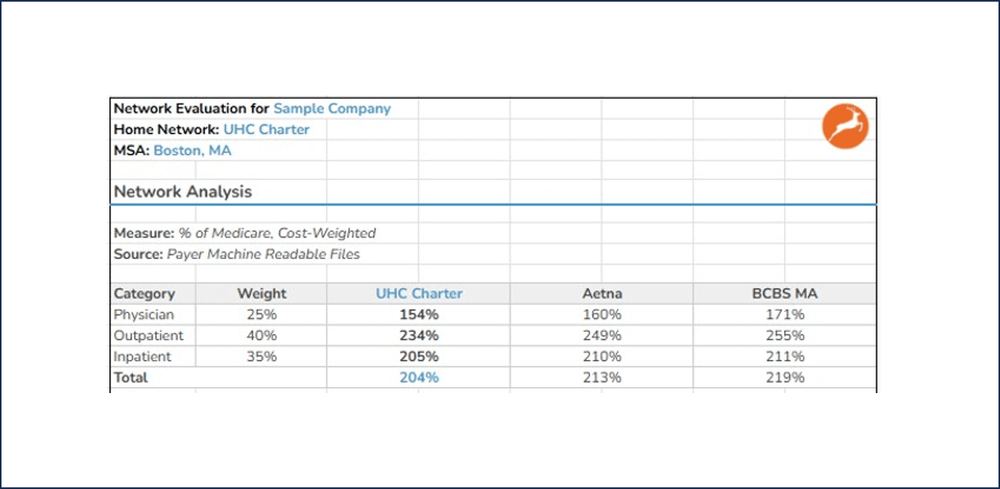
Medicare-based network comparisons offer a fair, transparent, and objective standard for evaluating provider networks. Medicare sets reimbursement rates using a rigorous methodology that considers resource use, geographic adjustments, and service intensity. These rates are widely accepted as a baseline for contracted rates between health plans and providers, making them an ideal reference point.
Why Medicare-Based Comparisons Will Change The Game
By leveraging the enriched price transparency data that Deerhold provides, brokers and stop-loss organizations can unlock significant advantages:
Objective Cost Analysis: Medicare-based comparisons eliminate the variability of billed charges, providing a clear and consistent benchmark. Brokers can easily compare provider contracted rates to Medicare, utilizing an INDEPENDENT source, helping their clients identify the health plan networks that deliver real value.
Improved Stop-Loss Risk Assessment: Stop-loss carriers can use Medicare-based network comparisons to assess the health plan network an employer group is utilizing, providing insight into stop loss attachment level, ensuring better alignment with potential risk.
Enhanced Employer Transparency: Employers and plan sponsors benefit from a clearer understanding of network performance, allowing them to meet their fiduciary duty by protecting the assets of their employee base.
Negotiation Power: Armed with Medicare-based network comparisons, brokers can confidently negotiate with health plans and directly with facilities on behalf of their clients. By framing discussions around a well-recognized standard, brokers can achieve more favorable terms and ultimately lower costs for employers.
The Cost of Healthcare in the U.S.: A Case for Change
To put the need for better cost analysis into perspective, consider these figures:
U.S. hospital prices for commercially insured patients are, on average, 247% higher than Medicare rates for the same services (RAND Corporation).
Employers spend nearly $13,000 per employee annually on health coverage, a cost that continues to rise year over year.
High-cost claims (over $100,000) now account for 31% of total stop-loss claims, highlighting the critical need for comparison across high-cost clinical categories.
These challenges underscore the importance of identifying alternative approaches to analyzing provider networks, going beyond the outdated "percent off billed charges" model. Medicare-based network comparisons provide an independent model with the clarity and consistency needed to tackle rising costs head-on.
It’s Time for a Smarter Approach
Deerhold’s price transparency data is bolstered by ancillary data sets that includes provider billing data, claim volumes and regional Medicare data, arming brokers and stop-loss carriers with Transparency Market Intelligence that can be used to make critical decisions for their organizations and employer group customers.
The time has come to leave "percent off billed charges" behind and embrace Medicare-based network comparisons as the new standard for evaluating provider networks. By leveraging Medicare-based health plan network comparisons, brokers and stop-loss organizations can deliver greater value to their clients, support those plan sponsors with fiduciary responsibility and remove the reliance of health plan provided ‘discount’ metrics when making these critical financial decisions.
By shifting the conversation from arbitrary discounts to objective benchmarks, we can create a more transparent, consistent and sustainable approach to evaluating health plan provider networks, ultimately impacting the spend of every healthcare consumer.
Contact us to learn how you can harness the power of Deerhold's PRIZM platform for smarter, data-driven decisions.


